


It is like a game of RisiKo! played on a board spanning 7 million square metres of land, along 27 kilometres of coastline. Here, however, the players are businesses and the map is composed of quays, docks, coastlines and the local communities that sit alongside the ports. The objective is not to conquer, but to create space to cater for the requirements of resilient and sustainable industrial development plans—those capable of generating employment, added-value and collective well-being. Within this framework, the port governance offices of the Western Ligurian Sea Port Authority act as the hub coordinating a complex productive mosaic which encompasses the Ports of Genoa, Prà, Savona and Vado Ligure. Their role is to provide the wide range of port companies with the support and stability needed to build a competitive advantage across the board, and to create the conditions to maintain and boost the employment of today’s 31,000 workers operating out of the Ligurian ports.
State port governance is often perceived as a purely bureaucratic function. In reality, it is quite the opposite. The Port Authority does not directly operate the port areas, quays and on-site facilities. Instead, these assets are allocated to companies across concessionary agreements administered by the Authority’s state port governance offices. This Department serves as the technical and legal driver which regulates all the activities carried out in the port, hinterland and coastal areas under its jurisdiction. The mission is to create the optimal conditions for the socioeconomic development of the ports, whilst simultaneously striking a balance with the preservation of the environment and the quality of life of the local communities.
State port governance is a highly complex and nuanced sphere of activity, whereby regulatory frameworks, extremely diverse operational needs, environmental protection, infrastructure projects and long-term strategic objectives must be continuously balanced.
Numbers that tell the story of an “extraordinary” effort
To date, the Port Authority state governance offices manage 1,085 concessions, corresponding to an equal number of business activities and operational areas in one of Liguria’s largest productive districts. Behind this figure lies an extraordinarily diverse ecosystem: major international port terminal operating companies, shipyards and their related supply chains, logistic service providers, leisure boating and environmental management services, as well as smaller yet equally vital enterprises such as marinas, beach clubs and food outlets. This wide-ranging network of concessions and deadlines generates a high volume of administrative activities each year, including renewals, authorisations, transfers and amendments.
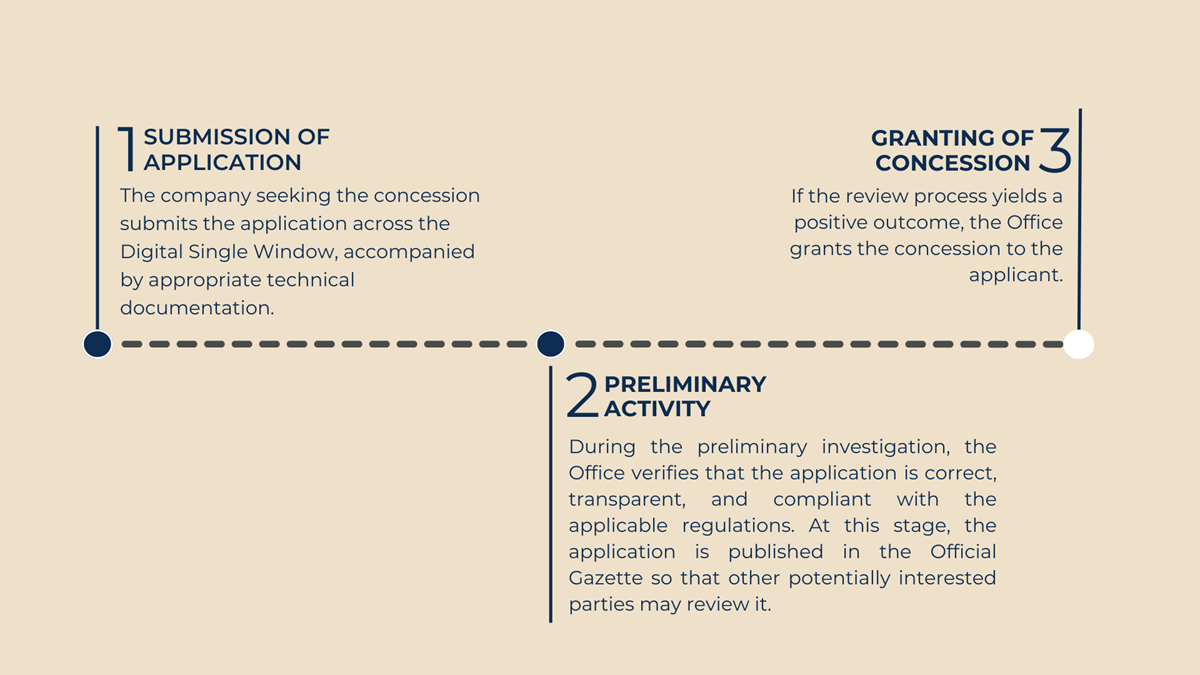
Access to the system is provided across the Digital Single Window (Sportello Unico Amministrativo – SUA), a digital platform designed to simplify concession applications and reduce processing times. Each application initiates a procedure involving multiple departments of the Port Authority, with technical and administrative assessments aimed at verifying compliance with port planning, safety requirements, proposed investments and employment impacts. Concessions—some with durations of up to 90 years—represent the primary instrument through which port companies plan their operations, investments and workforce. They are also accompanied by maintenance obligations, ensuring the protection and proper use of public assets.
The publication of concession applications on the Port Authority’s official website and in the Official Gazette guarantees transparency and open competition. The resulting comparative procedures require careful evaluation to identify the concessionaire capable of ensuring the most efficient and productive use of the allocated areas, particularly in terms of economic performance and job creation.
Key strategies for ensuring concession stability and governing the intense competition for land
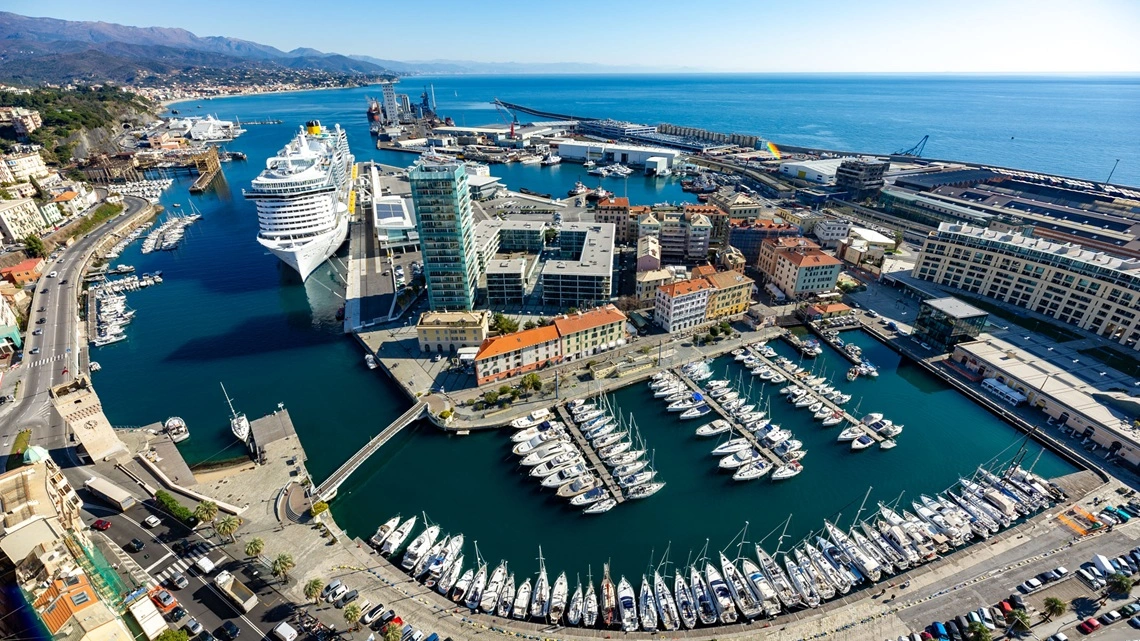
A view of the Ports of Genoa, Pra', Savona and Vado Ligure clearly illustrates the complexity overseen by this governance framework. The Port Authority’s jurisdiction extends over approximately 27 kilometres of coastline and 7 million square metres of port and hinterland areas. Within this space coexist major international terminal operating companies handling all types of cargo and passenger traffic, industrial plants, logistic service providers and amongst the top Mediterranean ship construction and refitting yards, located alongside coastal areas with a strong vocation in the tourism industry.
Together, the Ports of the Western Ligurian Sea form a multifunctional hub handling approximately 2.7 million TEUs and 64 million tonnes of cargo annually, in addition to over 5 million cruise and ferry passengers.
In a port range characterised by a high concentration of diverse activities, close proximity to urban centres, intense competition for land and resources and limited land availability, the state port governance department plays a strategic role. Even the allocation of a relatively small plot of land must be carefully assessed to ensure its most effective use in terms of economic and levels of employment development, competitiveness, environmental sustainability and integration with existing and future infrastructure.
In recent years, this activity has expanded further as a result of major infrastructure projects currently underway in the Ports of Genoa and Savona–Vado. State port governance offices manage the interaction between construction sites and concessionaires, coordinating with project managers and relocating companies when necessary. The primary objective is to safeguard business continuity and prevent disruptions that could delay the completion of strategic infrastructure works.
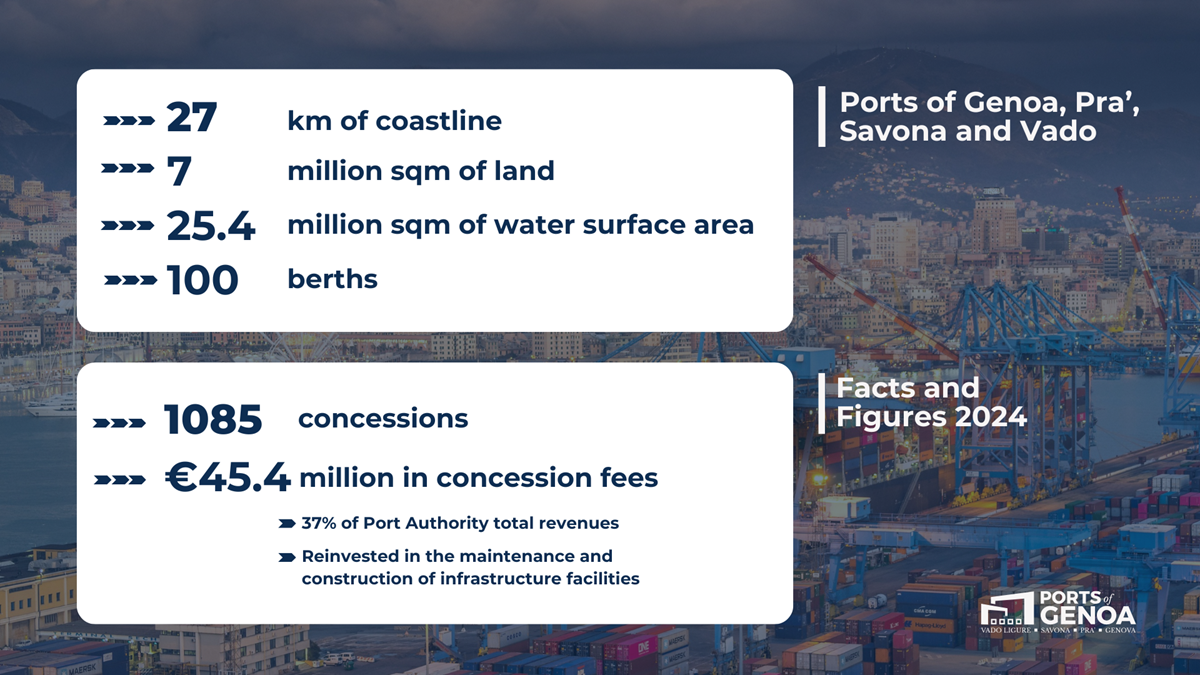
Alongside concession management, the state port governance offices also oversee the financial aspects of concessions. In 2024, concession fees amounting to over €45.4 million were assessed and invoiced, accounting for approximately 37% of the Port Authority’s total annual revenue. This is not a purely managerial accounting activity. Concession fees require periodic reviews, regulatory adjustments, technical assessments and frequent site inspections to verify the condition of the areas and compliance with concession obligations. The resources collected are reinvested not only in operational costs but also in the maintenance and upgrading of port infrastructure, with direct effects on the development of the port range and, consequently, on the economic appeal and employment prospects of the territory.
Although largely behind the scenes, the state port governance department makes a decisive contribution to the economic stability and long-term development of the Ports of Genoa, Pra’, Savona and Vado. The optimal functioning of the Ports of the Western Ligurian Sea also depends on this continuous and careful management of limited land, a highly diverse business community and the transformations shaping a productive territory in constant evolution.