


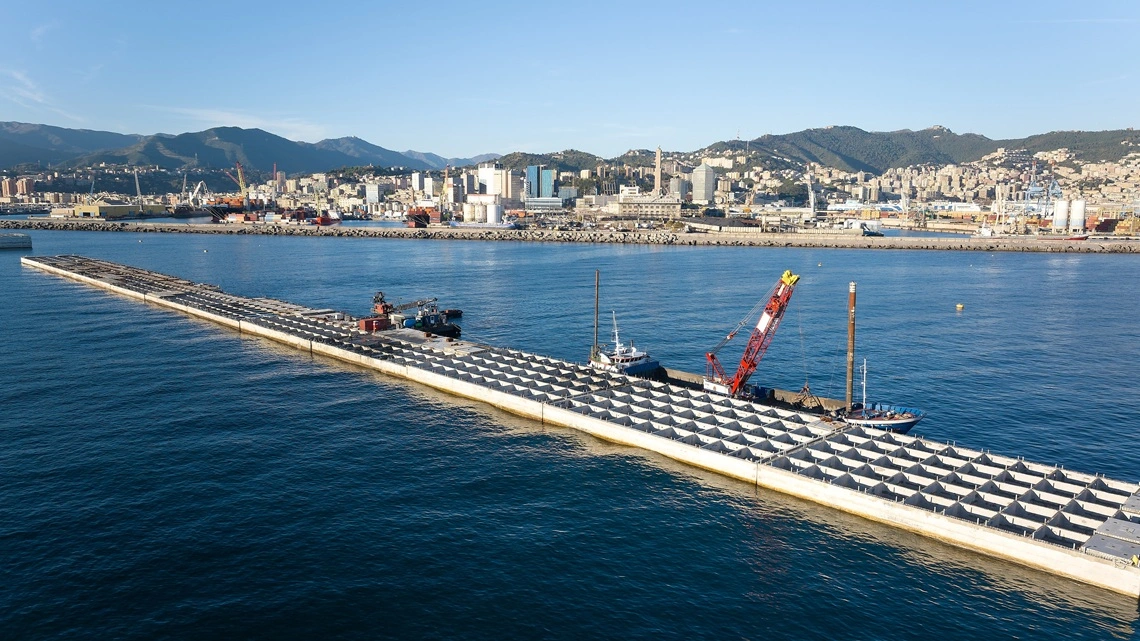
The construction of one of the most sophisticated feats of maritime infrastructure engineering in Europe takes shape both above and below the water’s surface.
The fifteenth caisson of Genoa’s new open-sea breakwater has been successfully positioned, in conjunction with the completion of the installation of over 50,000 giant stone columns on the seabed, that is, 79% of the total foundation. In addition, the consolidation of the solid underwater base has reached 87% of the total planned. Although invisible to the naked eye, crucial progress has been made on the foundation, in terms of the installation of 22-metre long drain pipe conducts to manage water flow at a depth of 30 m.
A key feature of this project is the constant supervision of the underwater construction site. Given the exceptional depths involved, up to 50 metres, the deployment of advanced high-tech monitoring systems, including the use of piezometers and inclinometers, is essential, transforming the invisible marine construction site into precise engineering data.
The newly installed reinforced-concrete cellular box, built in Vado Ligure’s floating dock, has been successfully aligned with the others which are already in place in Genoa’s Sampierdarena basin to form the future 6,200-metre breakwater. Commissioned by the Western Ligurian Sea Port Authority, the new facility will play a vital role in the local, Italian and European economy. Co-funded by the government, the breakwater has been designed to improve accessibility by sea to the Port of Genoa and to consolidate the strategic position of the port as a modern logistics platform serving the North Sea-Rhine-Mediterranean corridor of the TEN-T Trans-European network. Genoa’s New Breakwater will replace the existing structure further out at sea, to ensure safe access to the port on the part of the ultra-large vessels which require wider navigation channels and turning basins, and to protect the port and city of Genoa against the impact of climate change