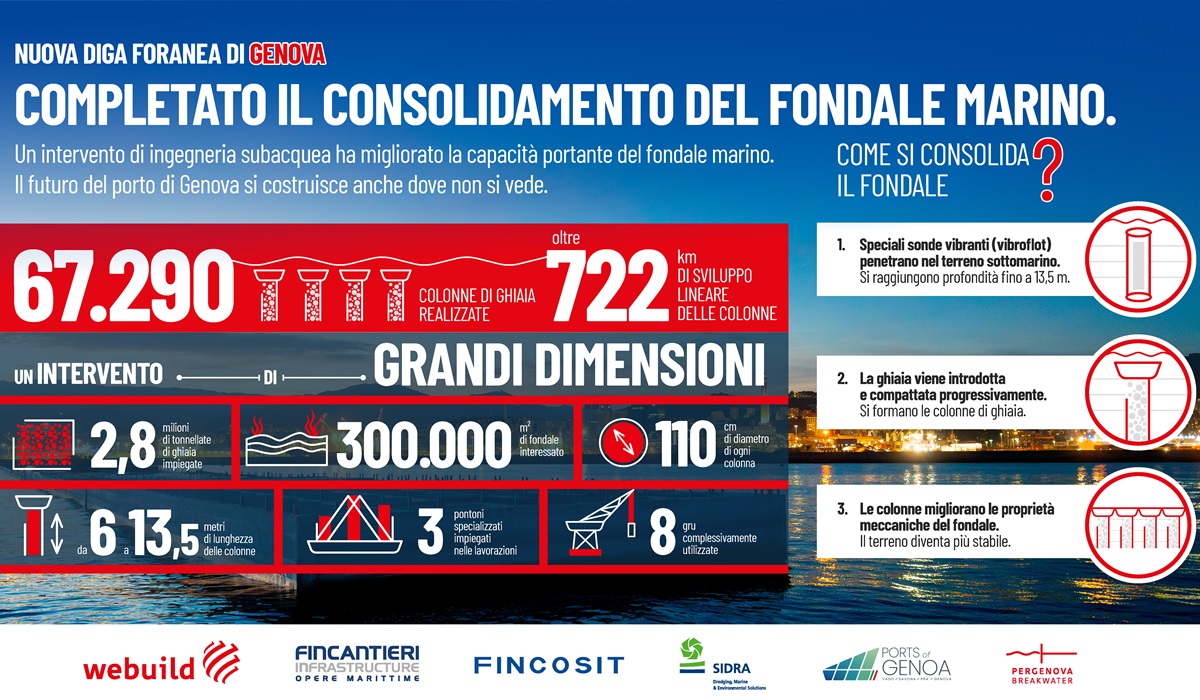


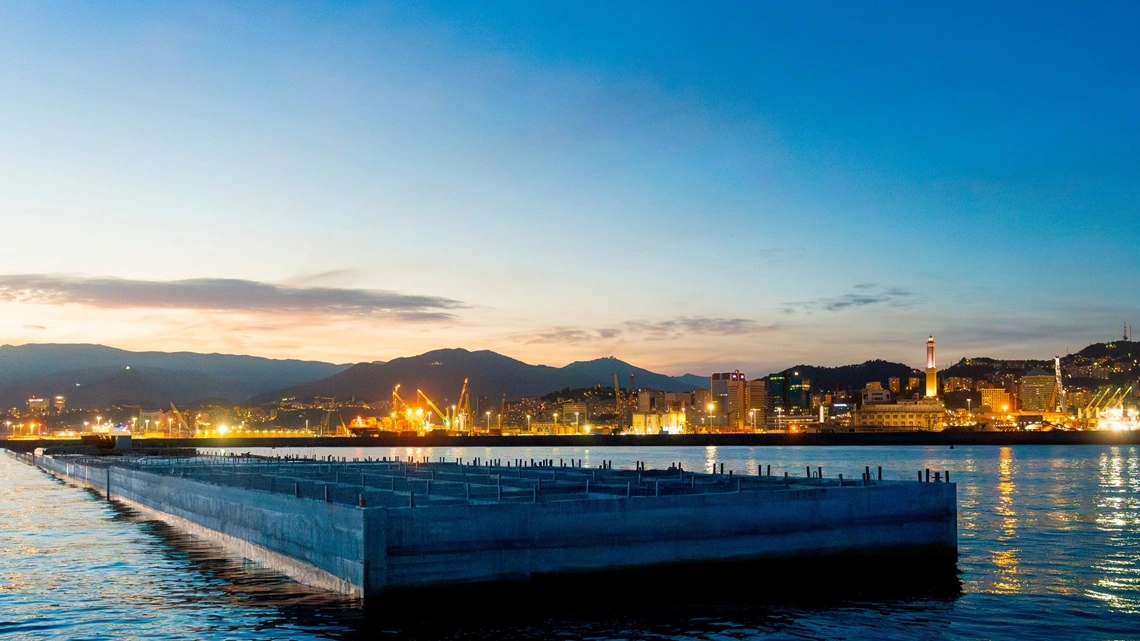
Nearly 300,000 square metres of seafloor has been stabilised. The installation of the 37th caisson brings the new breakwater to over 1.7 km in length.
Construction works, carried out by PerGenova Breakwater Consortium, led by Webuild, on Italy’s largest planned maritime infrastructure project, commissioned by the Western Ligurian Sea Port Authority, took another major step forward, with the successful stabilisation of the seabed, to ensure the long-term resilience and durability of the facility. Activities underwater progress alongside the installation of the monumental cellular caissons and, to date, form over 1.7 km of the new 6-km breakwater.
Over 67,290 giant stone columns, ranging from 6 to 13.5 m in length and with a diameter of 110 cm, have been installed at depths of up to 50 m. In total, over 722 linear km of columns have been constructed using vibroflots, needle-shaped devices mounted on cranes, lowered to penetrate the blanket of soil to create a water-filled hole into which gravel falls to create a compacted column. Approximately 2.8 million tonnes of gravel have been used to improve the stability of the groundwork, and the highly specialised offshore construction operations were conducted 24 hours/day, with the support of three dedicated pontoons and eight cranes. The construction works combine technical expertise with extensive logistical coordination and, according to data released by the Consortium, currently employs on-site over 800 skilled workers and 400 subcontractors.
Once complete, Genoa’s new 6-km open-sea breakwater will be the deepest in Europe and the continent’s second largest in terms of length. It has been designed o protect the oldest part of the Port of Genoa along the Sampierdarena channel, replacing the existing facility built in the 1920s and located only 200 m from the quayline. The new breakwater, located further offshore, approximately 400 m from the existing facility, will allow another Ports of Genoa’s basin to accommodate in full safety the complete line-up ultra-large container and cruise vessels which have increased in size and number in recent years. The infrastructure will also enhance the port’s climate resilience and enable the separation of vessels across dedicated lanes according to destinations.