
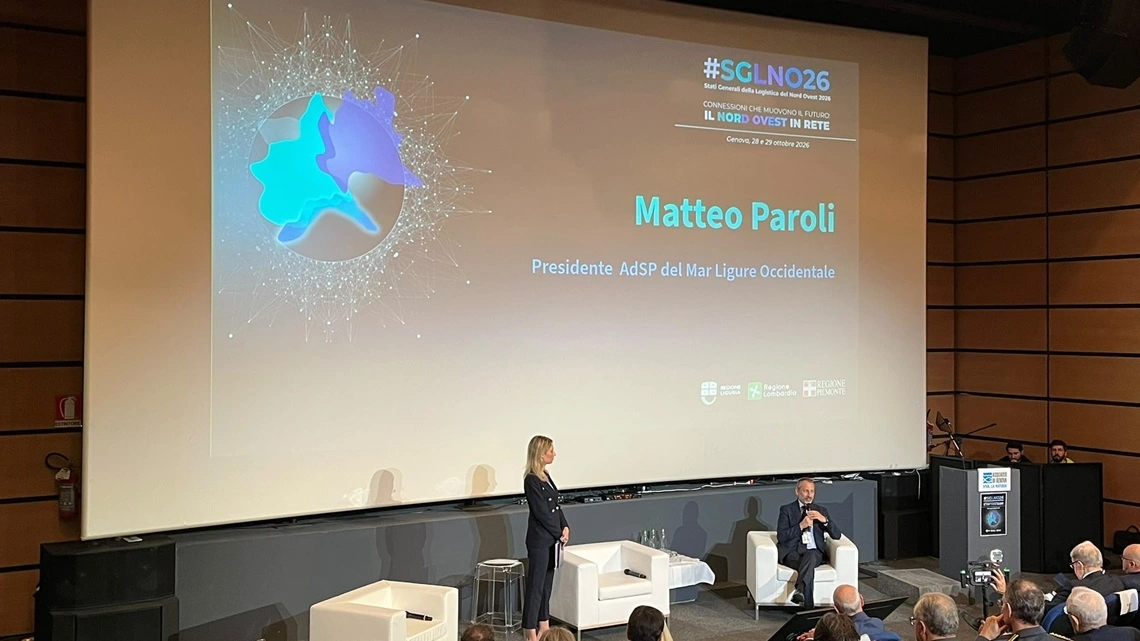
Integrating investments in major maritime infrastructure with efficient inland connections, boosting rail freight and improving coordination across the logistics chain are the key priorities outlined by Matteo Paroli, President of the Western Ligurian Sea Port Authority, at the North-Western Italy Logistics Summit, during the panel discussion “The Role of Ports in the Macro-Regional Logistics Network”.
29 October 2026 - The event, “Connections Shaping the Future: North-Western Italy as an Integrated Network”, was organised in Genoa by the Liguria Region, in collaboration with the Lombardy and Piedmont Regions. The two-day programme brought together senior representatives of central and local government, alongside industry professionals, to discuss how infrastructure, logistic hubs and manufacturing areas can be integrated to drive the economic growth of North-Western Italy and consolidates its position within Italy and Europe’s logistics systems.
As President Paroli pointed out, the Western Ligurian Sea Ports, which rank as the leading maritime gateway for 80% of manufacturing companies located in Northern Italy, accounts for approximately 30% of total Italian VAT import shipment revenue and supports 121,000 direct and indirect jobs. The Port Authority’s mission is to build upon the major impact generated by the Ports of Genoa and Savona-Vado on the local economy and employment, whilst progressively reducing the environmental repercussions of the port activities on the urban fabric. “A port that generates wealth, whilst seeking to minimise its impact on the surrounding area, ”remarked the Ports of Genoa President “is the guiding vision behind the future growth of the Western Ligurian Sea Ports.”
With an investment of approximately €1.4 billion, Genoa’s new open-sea breakwater is set to cater for the next-generation of ultra-large vessels, up to 400 metres long, by providing direct access and a wide turning basin in the Sampierdarena Basin, thereby unlocking new opportunities for a growth in volumes. “An infrastructure project of this scale must be integrated into a wider logistics network,” underlined President Paroli, highlighting the strategic importance of the forthcoming Terzo Valico, the new hi-speed/hi-capacity railway line connecting Genoa to the Lombardy catchment area and the wider European hinterland. The last-mile rail link projects, now nearing completion, will equip the Ports of Genoa to accommodate intermodal trains up to 750 metres long, in line with European standards, with a capacity up to 1,750 tonnes per train hauled by a single locomotive. These features, noted Paroli, are essential to establishing a rail freight service which is both economically viable and environmentally sustainable. In fact, the Port Authority has allocated approximately €230 million to rail infrastructure across the Ports of Genoa and Savona–Vado Ligure, including IT upgrades, enhanced safety systems and the electrification of intermodal areas, with the aim of ensuring seamless integration with Italy’s main railway corridors.
Rail currently accounts for approximately 30% of overland freight at the Port of Savona-Vado and 12.5% at Genoa. As the President explained, the objective is to boost the Ligurian Capital’s rail modal split to at least 30%. The Port Authority is also exploring incentive schemes for terminal operators, while promoting closer coordination between logistic providers, the manufacturing sector and public administrations. Specifically, discussions are under way with the Italian Customs Agency and other local public authorities to extend current operating hours, which currently run from 6 am to 6 pm. At the same time, closer forms of cooperation are being forged with the road haulage sector to ease road congestion and bottlenecks.
President Paroli also highlighted the opportunities emerging for Mediterranean ports amid congestion at major Northern European hubs and challenges posed by declining water levels in Europe’s main rivers. These factors, could in fact, further enhance the role of Mediterranean ports in international supply chains.
The Summit was attended by the Presidents of the three Regions: Marco Bucci for Liguria, Alberto Cirio for Piedmont and Attilio Fontana for Lombardy. The proceedings concluded with an address by Matteo Salvini, Italy’s Minister for Infrastructure and Transport.