


Matteo Paroli: “The competitiveness of the Ports of Genoa, Savona and Vado depends on the seamless integration of maritime infrastructure with landside supply chain networks.”
The Ports of Genoa attended the 10th edition of Think Tank Liguria 2030, the initiative promoted by TEHA Group in partnership with the Liguria Region, which for the past decade has provided an analysis of the region’s economic and social development, identifying scenarios and priorities for its future growth.
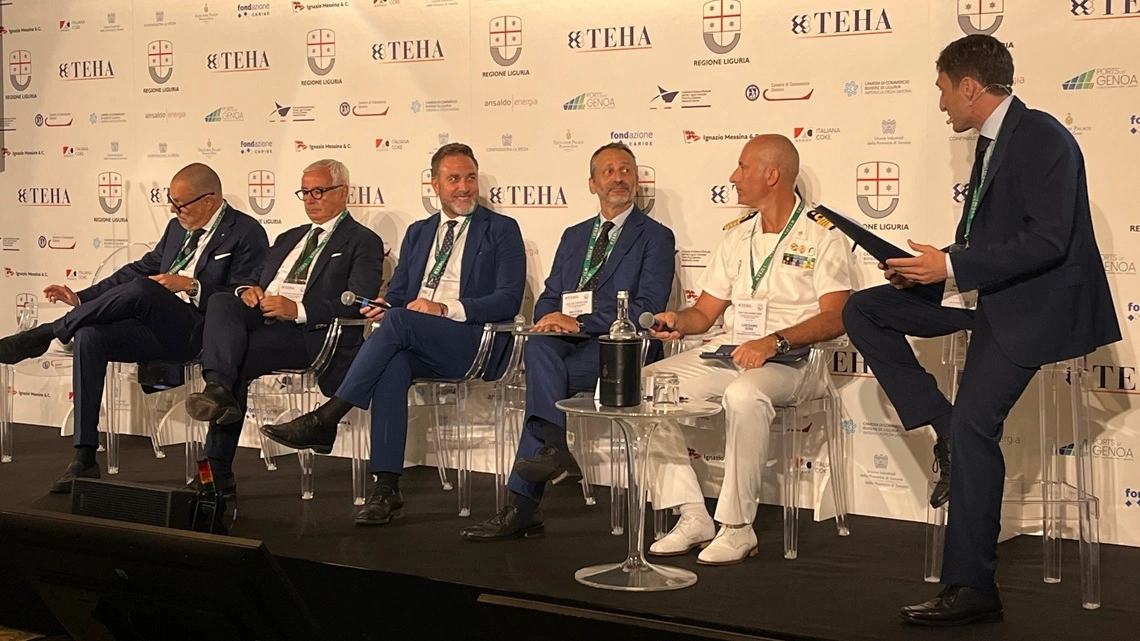
The President of the Western Ligurian Sea Port Authority, Matteo Paroli, was amongst the distinguished group of panellists invited to speak on “The development of the Blue Economy and the underwater dimension in Liguria: opportunities and development roadmap.”
During the discussion, Paroli highlighted the strategic role of Liguria’s port range within the Italian economy, focusing on the infrastructure required to sharpen its competitive edge and on the new challenges posed by security, technological innovation and the clean energy transition.
The Ports of Genoa President referred to the €3.6 billion large-scale infrastructure investment programme currently underway across the ports, highlighting as a top priority the integration of maritime works with the upgrading of overland road and rail connections. The construction of the new open-sea breakwater in Genoa, which has been designed to guarantee the access and manoeuvres of the next-generation ships in full safety, and the near completion of the Terzo Valico high-speed/high-capacity rail link represent two complementary elements of an overarching development strategy, aimed at boosting the role of the Ligurian ports as a modern logistics platform to serve international trade and the European supply chains.
“The new breakwater and the Terzo Valico rail link are not two separate projects, but components of the same strategy. Improving maritime accessibility equips us to accommodate the ultra-large vessels now sailing across the major global shipping routes; strengthening rail connections ensures that this additional capacity can reach the leading manufacturing and consumer centres of Northern Italy and Europe. The true competitiveness of the system lies in the integration between the port and the wider logistics network,” stated Matteo Paroli.
A central theme of the discussion was the security of port infrastructure, encompassing both the protection of digital systems and the safeguarding of port waters and maritime and underwater infrastructure. The Ports of Genoa President highlighted the growing exposure to cyber threats, noting that the Western Ligurian Sea Port Authority has doubled its investment in hardware and software dedicated to cybersecurity, from €2.5 million to €5 million. “Port security is no longer limited to the physical protection of port facilities. Today, it means safeguarding digital systems, communication networks, energy infrastructure and increasingly interconnected port waters. This is why we have doubled our investment in cybersecurity: the technological transformation of ports must move forward alongside the ability to protect them.”
In terms of maritime and underwater security, the President outlined an initiative launched with Fincantieri to develop and test new technological solutions for monitoring and protecting port waters. Matteo Paroli stated: “We have launched an initiative with Fincantieri involving the integrated use of drones and active and passive systems, including acoustic technologies, to upgrade the monitoring and protection of our port basins. Initial assessments have already been carried out, and we have had the opportunity to examine some of the technologies available in La Spezia. The aim is to move towards operational testing within a short timeframe.”
The clean energy transition represents another strategic challenge for the future of the highly energy-intensive Ports of Genoa activities. Paroli referred to an increase in the ports’ electricity demand, estimated at 1.7 terawatt-hours per year, which is expected to rise further with the forthcoming activation of the Onshore Power Supply facilities completed in August. The President also outlined discussions underway with Ansaldo Energia to explore potential low-impact energy generation solutions to meet the ports’ growing requirements, whilst making use of existing infrastructure in the Port of Genoa. One of the options under consideration involves the redevelopment of the site and infrastructure of the former coal-fired power station through the application of entirely new technologies, definitively moving beyond the previous model of energy production and also assessing the potential use of the heat generated to serve surrounding urban areas. “This is an option that needs to be assessed from every perspective, but it represents precisely the kind of integration between the port, industry and the city that we need to explore,” remarked Matteo Paroli.
In fact, In his closing address, the Ports of Genoa President underlined the need to establish closer cooperation between the port sector, industry, technology, defence and energy, identifying the ability to work together as essential to harnessing the expertise present across the region and addressing the new challenges facing the Blue Economy: “Liguria has a depth of expertise that few regions can match: in ports, shipbuilding, energy, research and the underwater domain. The challenge is not simply to preserve these assets, but to connect them and turn them into an overarching strategy that brings together industrial projects, innovation and highly skilled employment, within a shared vision.”